

thousand-pointed star
Some random thoughts and life updates

(I’m in my second trip-hop phase. Literally cannot go wrong with trip-hop, amazing cross-genre phenomenon, still sounds amazing. Is there anyone on earth who pointedly and genuinely doesn’t like it?)
Main news: I somehow managed to traverse the Ticketmaster website and was one of an apparently lucky few to get through the queue and buy O2 Madonna tickets on Livenation presale - something I assumed, based on big 2022 news stories, was impossible!! Am freaking out, like a lot. My seat is one of the weird high up ones but from some internet scouting I think the view should be OK. Now just let me dream about the ideal tracklist for a ‘Greatest Hits’ show…
*
I am mentioned a lot in this article about the Aesthetics Wiki, the internet visual archive I founded in 2018 that ended up becoming a Lord-of-the-Flies-esque free-for-all for teenagers who are in dire need of culture and narrative. When I read it under the table in class I was like ‘Oh no they are making me sound like a very-online and simultaneously antiquated villainous child abuser’, but I have realised that this is actually a very GOOD thing in the greater paper trail of my life, and I may actually be accomplishing the daring posthumous camp-ification of Tumblr culture through my own personal narrative (!). I’ll put it this way, the Dilettante Army girls are doing for me what Frank Perry did for Joan Crawford in 1981, ie. turn her into an indisputable legend whose life story and mannerisms would far outlast any of her contemporaries in our shared cultural memory. The public enthusiasm for the wire hanger bit or the axe bit far eclipses any sort of public enthusiasm for the actual films she made during her actual life. When these films really are screened and watched, though, the resultant violent creepy subtext is DELICIOUS. There is no other ‘40s actress who has nestled herself so deep into the fabric of Western culture due to events that may not actually have happened. More people should still watch her magisterial A Woman’s Face.
*
My dad has a weird thing where he is obsessed with Trumpton and its sister towns Chigley and Camberwick Green, so I was psyched to find this and am now very curious about the 90s rave scene in general. Imagining a fire station staffed by all the Anns in my life - Baxter, Bancroft, Bannon and Blyth, the last of whom is STILL ALIVE at 96!
My dad is also obsessed with funicular railways and Franz Lizst which explains a lot.
*
I feel that my general knowledge is improving daily due to the reading habit I have sustained in the past two years - faster than it ever did in seven years of compulsory secondary education. This has made me reflect on the idea of ‘general knowledge’ - well - in general.
When we prize some knowledge over other knowledge, we are essentially privileging the ruling class over everyone else (especially in the UK, where ‘class’ has little to do with present economic circumstances and much to do with family and culture). This does not mean we should stop valuing the information we do value - it means we should improve the education system and create equal-opportunity pathways to a) wide independent reading, b) high culture, not because of some Pygmalion-esque saviour complex but because everyone has a right to our shared cultural heritage and nobody should be artificially blocked from appreciating any part of it. D.H Lawrence was working-class but became a huge part of twentieth-century literary history - and thus also our body of prized, prestigious ‘general knowledge’ - because he was given access to books. If there were no more D.H Lawrences it would be sad - just as sad as if we played down the author’s origins because of the body of culture of which his work is now considered a part.
When I was in Year 13 some senior teachers at my school read that - according to university lecturers - undergraduates in the late 2010s had really awful general knowledge compared to previous generations. The teachers were like ‘Not from our school! We must fix this!’. They decided to solve the problem not by encouraging us to read, or by altering their approach to the curriculum (which was ‘skills-based’, not ‘knowledge-based’, more later), but by setting up a simulated in-assembly version of the high-class UK quiz show University Challenge. One of the rounds ended up being purely about things that happened in Game of Thrones (this was obviously not the knowledge lecturers wanted - besides, it was unfair to students who hadn’t engaged with one very specific, 18-rated, IP). I was very very confused at the reasoning here - surely students with good general knowledge would just self-select and no change would happen? Did they really think they could ‘improve’ the general knowledge of the student body simply by testing it publicly? How did they expect to improve it when they themselves had no idea what it was supposed to include?
I have good qualifications, got into university, and left school without knowing who Napoleon was or what he tried to do. I was very confused when I tried to read Les Miserables a few years later. My friend left school having never heard of Chairman Mao. It came as a genuine surprise to me that I could learn large volumes of information via nonfiction reading alone, and that this might be more effective than Googling or listening to an online lecture - that instead of relying on disparate online factoids, a good nonfiction book would fill in all the context for me in a logical order and lead to the sort of understanding that leads to meaningful links and thus helps me produce new ideas (example - if I read Madonna’s Wikipedia page I would learn that she grew up near Detroit. If I read a good-quality published biography of Madonna - for example, the Lucy O’Brien one - then I would also learn what the music scene was like in Detroit in the 1970s and how she engaged with it, leaving me free to make all kinds of other links for myself).
I think my education was affected by the fetishisation of a) ‘higher order thinking skills’ misinterpreted from Bloom’s Taxonomy, b) online, ‘interactive’ learning. The first meant that teachers prized ‘creation, evaluation, analysis’ - I was constantly expected to ‘create’ where it posed me no intellectual challenge or had no relevance to the actual skill I was meant to develop (for example, in English class, I remember being told to ‘make a poster about Romeo and Juliet’ when we hadn’t actually read the play yet). Detailed, minute analysis of language trumped any engagement with the humanity of a text, making literature classes tedious - nothing like the joyful exploration of fiction I have rediscovered over the past two years and to which education should be a supplement, not a roadblock. Most projects came with a self-conscious and bureaucratic requirement for ‘evaluation’. The last two points are mainly the fault of the English examination system for humanities, which should be overthrown ASAP. The first is probably mostly teachers being overworked or obsessed with ‘fun’ and student engagement (learning from books, BTW, is fun, lots of actual historical information is inherently fun even when presented with no frills or additions, and I believe we learn the opposite of this from the ‘skills-based’ teaching approach).
The ‘interactive learning’ fetish is self-explanatory. I am still confused about the number of iPads owned by individual departments at my (state) school. Were they being paid off in some way to create repeat customers? Apparently every student at said school now also has to bring in a personal Chromebook, which worries me and SCREAMS ‘conspiracy’ actually, and also if you are carting a personal laptop around school and constantly preoccupied by some part of it then how do you find time to read? It’s kind of like we embraced the introduction of ‘smart technology’ but skipped the invention of the printing press… anyway…
*
I am FINALLY in my Clarice Lispector phase (what took me so long?). It turns out that my obsession with anagrams, acrostics, numerology, odd rhyme schemes, Ray of Light, foreign writing systems, etc etc, is actually all just linked to some weird inborn connection with Jewish mysticism (like - I do not believe in a deity really, but I have always felt that manipulating words lets me in on some great huge primordial secret which is the absolute immovable truth). This obsession is something Lispector also exploited to a very high degree, and I can’t WAIT to find out more! (I am still working on something linked to the bits of Sanskrit sung on Ray of Light).
*
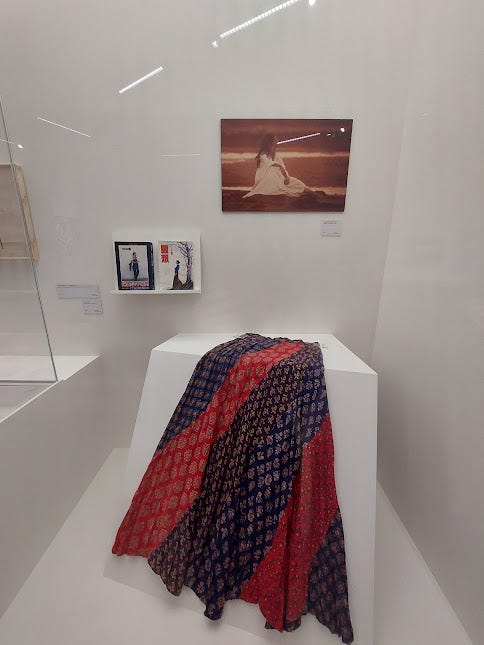
Taipei campus folk readers: get yourself down to the Fine Arts Museum before the 26th of Feb as the ‘Wild Eighties: Transdisciplinary Taiwan’ exhibition has a corner devoted to Sanmao, including lots of personal photos and the actual skirt she wears on the cover of 隨想! I was very excited to see this as I’ve been looking for 80s psych remnants in museums my whole time here. There was also a ‘banned’ disco room with original copies of some of the records previously recommended in this newsletter exhibited under colour-changing lights!