

The rise of the Glossier Intellectual
The new Gen Z thinker has a very shiny face

It’s you, but better! You have strong bushy eyebrows and high cheekbones and a face so dewy it could have been submerged in a river literally seconds ago. Your pores are sort of there, but not really. The sun is shining through your skull the way it would through the hind leg of an Italian greyhound. You are wearing a lip balm flavoured like the sort of food that exists on Twitter and not real life. It is 2017 and you have given yourself over to Emily Weiss’s cult of Glossier.
You probably thought the Glossier Girl was dead.1 The Amoruso-style “girlbossing” of the Glossier era fell apart during 2018’s “Summer of the Scam,” when Anna Delvey and Elizabeth Holmes became news-cycle fixtures.2 In 2020 the company got itself caught up in the crossfires of a second Black Lives Matter reckoning. Weiss hasn’t been Glossier CEO since 2022. In that year women’s coworking space The Wing shut down, basically heralding the death of the Girlboss Sisterhood - the pink-tinged camaraderie available only to forward-looking women of exactly the same economic class.
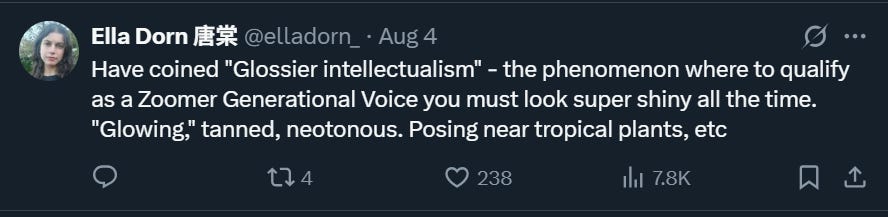
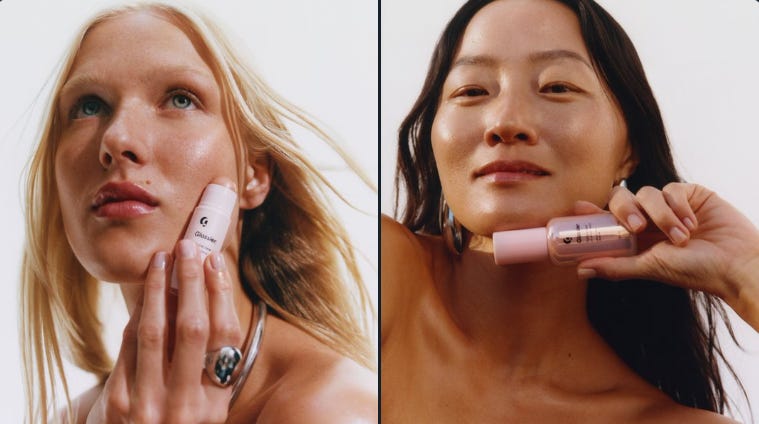
But there is a change in our midst. A few days ago I posited the concept of the “Glossier Intellectual,” a new sort of Gen Z thought leader who looks as permanently wide-eyed, shiny and flushed as a woman advertising Cloud Paint. There have been Glossier Intellectuals among us for ages, but the phenomenon’s transformative effect only became clear during the recent onset of Substack’s first ever plagiarism scandal.
Basically: Northwestern “dual PhD” student Maalvika Bhat (“learning-loving and meaning-making”) is currently at the top of the Substack leaderboards for publishing essays on tech and culture. She also has over 60k followers on Instagram (locked) and over 180k on TikTok (comments removed). Allegedly, fellow Substacker Katie Jgln found part of one of her own essays replicated, with minor tweaks, on “learning-loving and meaning-making.” (This is a stupid name for a newsletter - I have to say it. Sorry!!). Bhat’s TikTok video about the essay had done big numbers. Her Substack post was vastly more successful than Jgln’s.

What struck me here was the transformational effect of Bhat’s online self. The offending party got away with this for so long because she is the visual and textual epitome of the Glossier Intellectual - very young, shiny, lowercase, “authentic” - and Jgln isn’t. This is a marketplace of ideas - but people will more readily buy them if they come with a certain aesthetic experience.
The Glossier Intellectual is the early-twenties extension of the female Teenage Messiah, a concept I have also written about at length; many Glossier Intellectuals once were Teenage Messiahs, participating in Rookie Magazine-adjacent acts of feminist and ecological activism. Like the Teenage Messiah, she draws in the older media classes with her worldly insight and capacity for prophecy, which is so prodigal it actually makes their brains explode. In their confusion, readers assume the source of this insight must be youth itself.3 Zoomerness thus becomes important intellectual currency.
Unlike the Teenage Messiah, the Glossier Intellectual is generally very self-aware. This can be a boon for a woman in her early twenties the way it never can be for a teenager. There is no stage mother and no secret underlying media complex. She understands that she is a marketer engaged in the business of self, and that the term “Gen Z” is like catnip to a certain older subsection of media professionals. So she will call herself a “Gen Z philosopher” (in Bhat’s case it’s “your fav gen z philosopher xx”).
She will try to make her authenticity very clear by writing in lowercase, an affectation that actually takes a lot of effort to pull off consistently. Glossier Intellectuals must conduct themselves in an earnest way. She can’t crack jokes or get into epic Fax Wars; she can’t say “Zoomer” because it indicates proximity to New York’s irony-first downtown scene. She must bare her soul and explain absolutely every part of her mental and physical life to those interested.
The desire to recreate the lost world of 00s blogging is a Zoomer trait. The authenticity isn’t. See Emily Weiss’s Into the Gloss, the late-00s-style blog that eventually became our own Glossier. Weiss started out as a “superintern” on reality show The Hills and then furthered her network of contacts by asking bright establishment women to explain the contents of their bathroom shelves. Into the Gloss is probably our foremost example of Authenticity as Secret Flex.
˗ˏˋ ★ ˎˊ˗
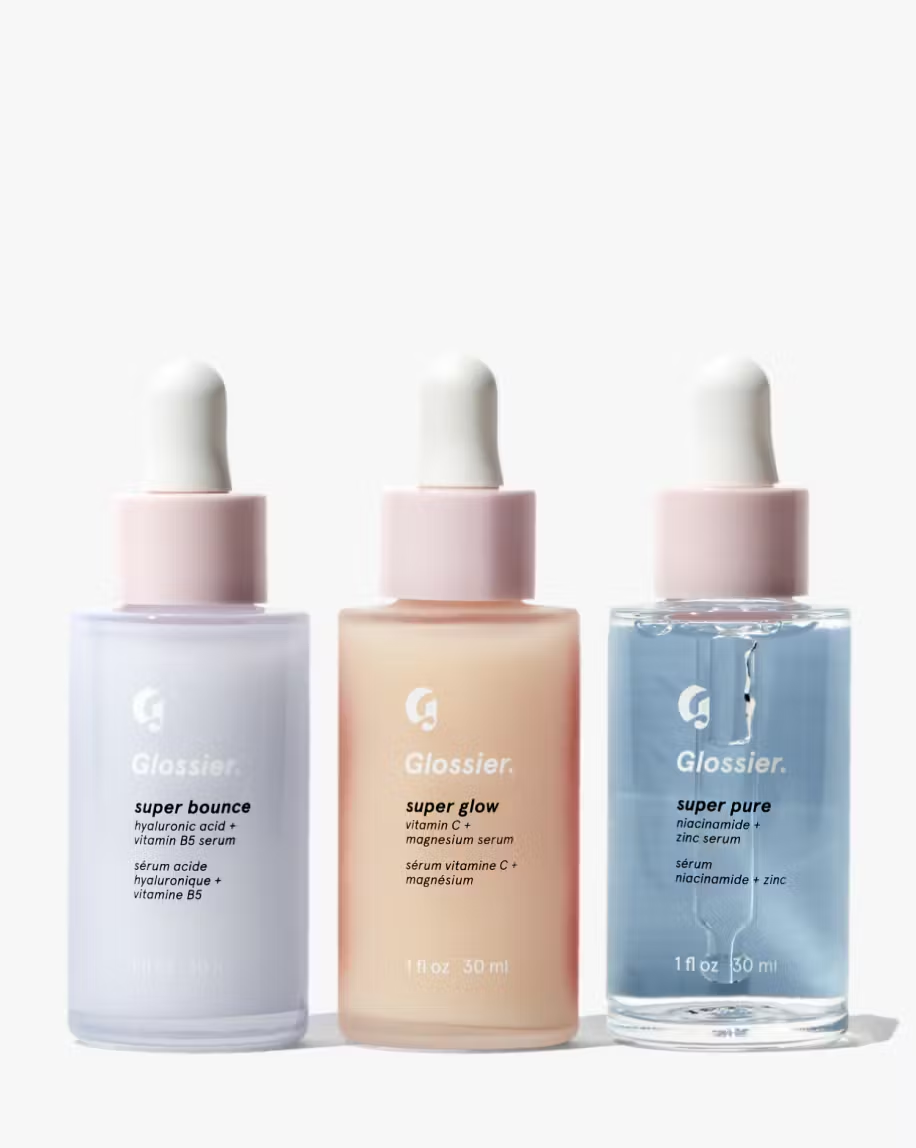
At its inception, Glossier was makeup for women who liked the idea of bonding in nightclub bathrooms but also hated all the larger implications of makeup: the “pink tax,” that Margaret Atwood quote about “male fantasies.” The general effect was of gentrification, but for your face. No trace of the Haunted Twentieth Century was allowed to stick without a lengthy redesign; any vintage references are in the eye of the beholder, who can make of timeless, placeless Futura what they will. If there is any accent colour it is “millennial pink;” really a gender-neutral pink, the hue of a period-typical, Lean In-adjacent “ambivalent girliness”. The blushes and lip balms are in metal paint tubes; the skincare packaging looks like something you would give to a doll made of Bakelite. The advertising has virtually zero sex in it; the lipstick shades are called things like “Coupe” and “Portrait.” (See the flipside: the “Better Than Sex Foreplay Mascara Primer;” the way NARS tells you to “uncover endless ways to orgasm.”)
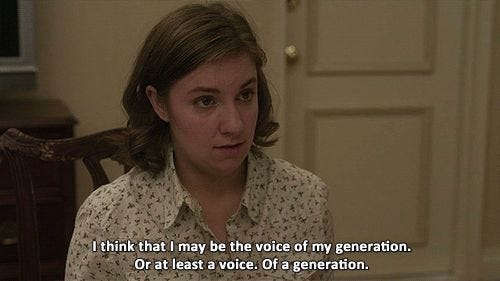
The original Glossier fans sought to escape the past. But Glossier Intellectuals seek, more than anything else, to represent their generation. It is the highest compliment you could give any of them; they are hyperaware that they stand in the eyes of the agèd for a few million other young women too. Thus they pose as delegates, with long thinkpieces about “girlhood” (EW, also - cute!) and female friendship and the corrosive effects of social media upon the Zoomer mind. Sometimes “voice of a generation” is used with such relish by outside commentators that it actually seems more like a goad at other, less successful writers in the same generation.
Of course, this is all very ironic. Glossier Intellectualism is far removed from any actual Zoomer movement. Imagine a young woman affecting Didion’s Californianisms and venturing gingerly into Studio 54. Glossier’s blushiness has nothing to do with the “low-trust,” 1990s runway-style Gen Z makeup trends of the 2020s, the heavily-liplined “office siren” and Brat-adjacent Gabbriette look. A Glossier Intellectual probably uses multiple lip products, but she is never allowed to come across as if she knows what a “lip combo” is.
There’s a shift we are missing here. We have all been messed up by the internet, but in different ways. Millennial neuroticism involves rewriting and reshaping in order to flee from a time before living memory, and Gen Z neuroticism centres itself on the real-life excavation of tiny bits of history. This is not cut-and-dry; it works as a continuum, with more of the first in the early 2010s and more of the second in our own mid-2020s. You got the depersonalised “aesthetic” wave (“a place and time with no people in it”) from the oldest millennials (cf. Lana Del Rey).
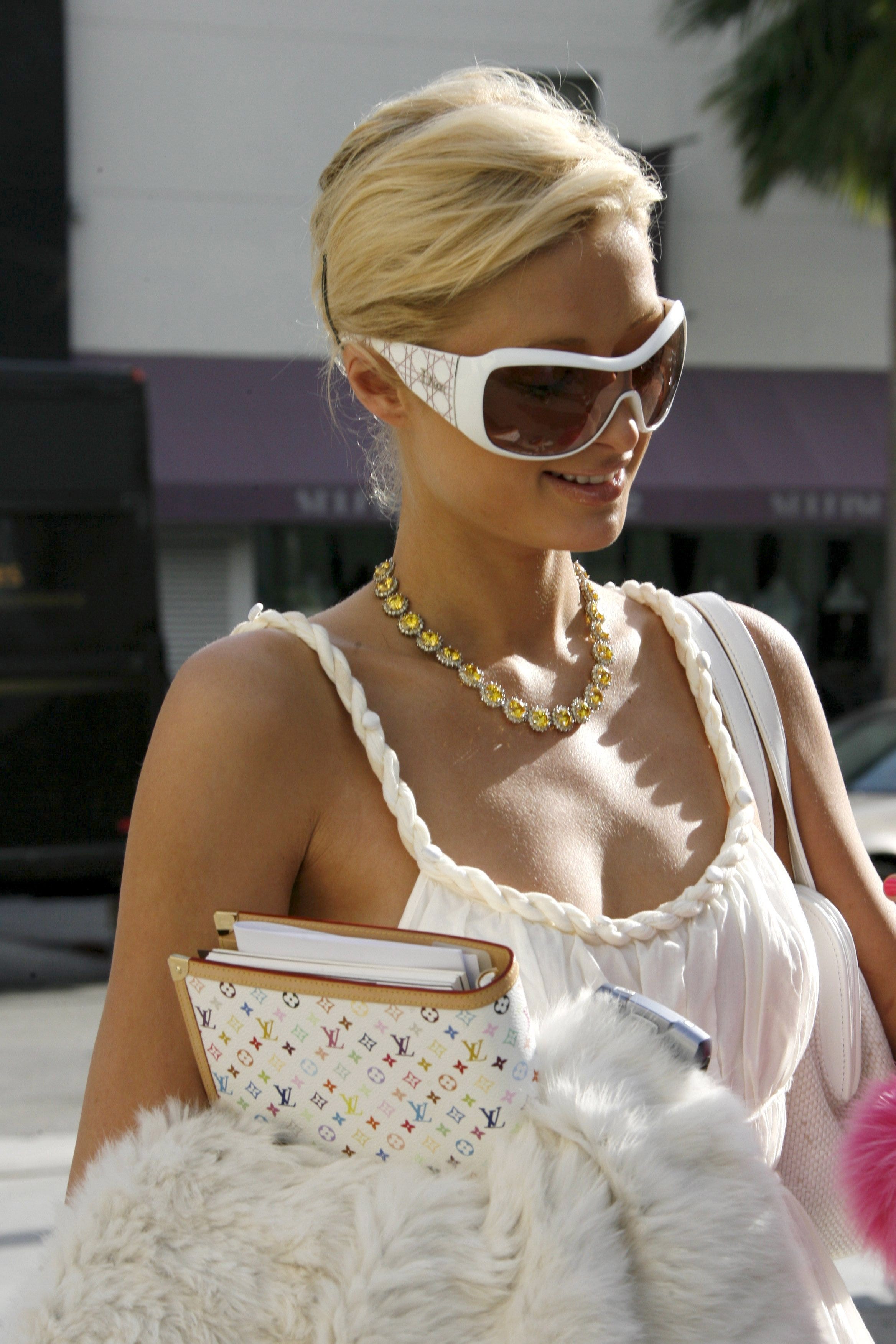
From here emerged the off-pink Futura schema of Glossier. But the Zoomers proceeded to smash the visual particles together at warp speed, expanding the imaginary world further than the boundaries of the moodboard and accidentally bringing it into real life in the process. Thus we find the fungible “trend cycle” and “trinkets” and the eternal Depop reselling market, guided by recirculated paparazzi photos of Britney, Paris and Nicole.4
˗ˏˋ ★ ˎˊ˗
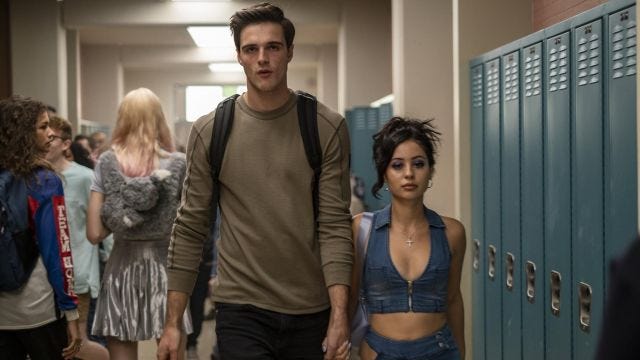
There is no major, institutionally-approved reference point for Zoomer life yet. Euphoria is at least a reference, but it’s so escapist you’d be hard done to find anyone who actually maps their life onto it (see the memes about how improbable the costumes are). Young online women feed instead off HBO’s Girls, which is a major reference point for millennial life. “I think I am the voice of my generation,” says personal essayist Hannah Horvath (Lena Dunham) at the start of the show’s 2012 pilot.
But Hannah and her friends will never catch up to whims of their generational tastemakers. The struggles of the Girls basically all rotate around their failure to assimilate into the forward-looking Glossier class. Hannah is twee and too into the kind of cutesy excess that will eventually become “snackwave.” Her university nemesis manages to publish an essay collection before she does, the sort of thing that would probably get her profiled on Inside the Gloss. Marnie has Clean Girl pretensions and is in the right art-world circles, but she dresses, acts and sings a few years behind - she will never be cool enough to understand the futurity of the Glossier Girl.5
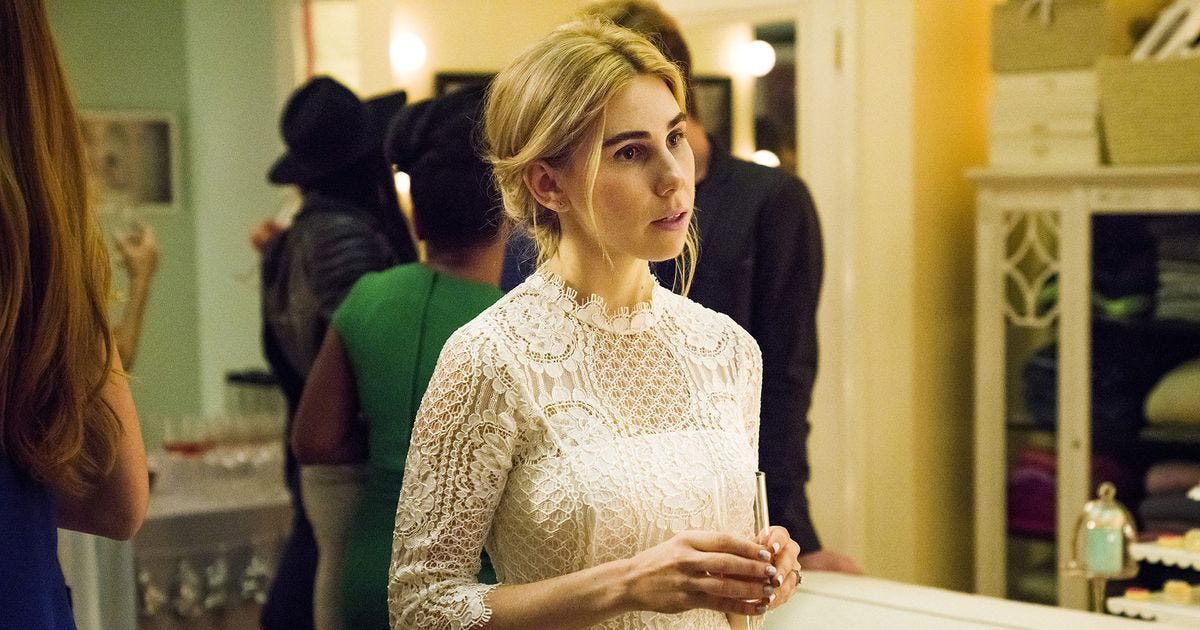
Shoshanna is the youngest Girl. She never loses her idealism; her whole character arc is built around becoming the sort of woman who might eventually work at Glossier. Eventually she realises that if she is ever to get there she will have to dump everyone else in the group. “See those really pretty girls out there with like, purses, and really nice personalities, and jobs?” she says, “Those are my friends now.”
Of course the Girls eventually had to grow up. None of them managed to become an actual generational voice - but now, in their thirties and forties, they are the gatekeepers of the literary world. They would rather cast their eyes onto the future than try to make meaning from the past, which is full of personal disappointment. They loathe the establishment even though they were around at the last point in which it could get you anything. In their attempt to avoid the twentieth century, they choose a new set of public intellectuals who never even managed to touch it.
These intellectuals, in turn, are doomed to be protégés for their entire twenties. If they are to “speak for Gen Z,” then everything in their lives must be a studied performance of generational position. Either they are giving big-sisterly advice to an imagined audience of even younger women (“Awwww!” says the audience), or they are posing as your mysteriously-sagacious younger sister, a sort of magical hybrid between Little Girl and Noble Savage. This is why their eyes look so big and their skin looks so shiny. Glossier no longer stands for authenticity. It is actually more like drag makeup. You must always play the prodigy.
I LOVE Anna!!! Even more than I love the girls behind the Bling Ring, a spiritually-Gen Z film. Perhaps the key to actual authentic zoomerism = siding with the scammers. (It all lines up if you have faced the economic conditions we have).
This is the most patronising thing ever + why I’m only naming the writer who 100% did something wrong. Lots of Glossier Intellectuals are clearly very well-read and great at thinking! They are just doomed by the expectation to perform a generational viewpoint all the time.
No relevance to the issue at hand just REALLY want to talk about it - am completely obsessed with looking up 2000s celebrity Scientologists on Getty Images, have been for years. Apparently phone provider Helio was a Scientology front so loads of them are holding the brand’s Kickflip phones. This kind of dark mysterious atmosphere was missing from the Glossier era.
Funnily enough Marnie’s character was based on Audrey Gelman, who founded The Wing.
it's interesting how much gen z has been forced (?) or conditioned (?) to associate their aesthetics so strongly with their opinions. not a new phenomenon, but makes sense when you see all the tik toks with text that has nothing to do with the video it's overlaid on-- you can't have anything to say without having a background first.
The line about being a "hybrid between Little Girl and Noble Savage" is a good one, as is the idea of the Teenage Messiah. I've long felt that there's this political/social ideology saturated with this YA-derived idea that the most heroic and wisest among us all is a precocious teenager, and it's precisely her naivete and lack of experience that gives her her ultimate power. Acquired skills, knowledge, and wisdom act as detrimental forces, giving an unwanted patina to the once-gleaming shine of the ingenue.
And then we wonder why so many young people think life ends at 25, or that even old people revert to acting like petulant tweens online.