


At over 7,000 words, this is the longest piece I have ever published. You will probably have to open it up in web format and also find somewhere comfortable to sit and maybe put on some background music (I recommend the Kelly Chen BPM Dance Collection). If you enjoyed reading, please consider a paid subscription (two paid posts will go out this month too).
Freya India is concerned about us and she wants our parents to know it. She has spent the past few years hopping from Triggernometry to The Lotus Eaters to Louise Perry’s Maiden Mother Matriarch, from Spiked to Quillette to UnHerd to the Spectator to Jonathan Haidt’s After Babel to Bari Weiss’ Free Press to Girls, her own very grating Substack. Like a blonde version of the laminated sign on the exterior wall of a Sam Smith pub, she implores us to get off our phones and live in the moment. She thinks we’re being short-changed, that we’re giving too much of ourselves to Big Tech, Big Pharma, and Big Dating App. We are selling ourselves off. We are being exploited. We are not just Girls. We are Girls.®
And she’s got a solution! Oh wait, no she hasn’t. But she has got a book, one with rave reviews from the safer members of her podcasting circle and a nothing-at-all-is-going-on-here blurb from her sometimes-outré publisher, Swift Press. “Each chapter of GIRLS® focuses on a common anxiety in adolescent girls’ lives,” it says, “from insecurities about our faces and bodies, to our reputation and social status, to our friendships and romantic relationships.”
India and her publisher have had one over on the reading public. Some Goodreads reviewers think Girls® is a good-faith pro-woman tract; some bookshops have tried to sell it for International Women’s Day. It’s not their fault; the book’s emotive marketing and pink cover means it slots neatly into an existing feminist niche. As a supposedly catch-all critique of online trends, it fits into a slate of top-selling anti-Big Tech publications, like Sarah Wynn Williams’ Careless People and Jonathan Haidt’s Anxious Generation. (India writes for, and cites, his Substack; he’s duly provided a cover quote). India’s meant to speak for Gen Z, but her followers are predominantly middle-aged, and she apes the stock style of many a “Waterstones Dad” book in sort-of gesturing towards a Yuval Noah Harari-style Big Picture.
This is all window dressing. The feminist concerns do not exist; the personal experiences are embellished. India’s criticism of social media is the shallowest you’ll find in any book written for the general reader; her criticism of commodification ends at the word “commodification.” The point of Girls® is to gather mainstream consensus for the hard-right’s ideas about working women, birth rates, and civilisational collapse. And its author is a perfect Trojan horse.
I have written at points about the magical children, or “teen messiahs,” or more usually “tween messiahs,” of the left-leaning press. I saw their rise first-hand because I grew up reading both Rookie - the teen-messiah publication of choice - and the Saturday edition of the Guardian, whose journalists used to go mad for figures like Malala Yousafzai and Greta Thunberg.
The teen messiah is precocious, brave, and exceptionally sensitive to the dangers of the modern world. Her youth lets her see through everyone else’s pretences. An early brush with some issue has inspired her to dedicate her life to activism. Like a mini-Cassandra, she knows something worse is coming - and she’s risen to public prominence so she can call adults to action, too. The grown-up public follow her in awe. She gives them hope for a better future. They’ve messed up. But perhaps the next generation will be different. They will be like her.
India might be the first proper version of this archetype on the contrarian right, which is actually really funny because she is 26. She, too, is remarkably sensitive. In interviews she keeps calling herself “old-fashioned”; in her introduction to this book she sounds like the little boy in Emma Donoghue’s Room, who only has vague, heartrending inklings of the Josef Fritzl-esque situation in which he lives. Something feels wrong; she’s permanently depressed and anxious. She thinks she’s alone; she doesn’t know why things are so bad. Then there are omens. Her classmates start to cut themselves. They start “opening up to [India], admitting that they [suffer] from anxiety and depression.” “Gradually I found girls talking online about this feeling,” she says.
The pandemic hits. She finally has “time to think about why I [feel] this way.” Right away she starts “pitching to magazines and newspapers, trying to put into words about how I felt about social media, about dating apps, about family breakdown, about how girlhood felt in the modern world.” She is pulled forth by a polemical higher power, as Julia Cameron says should happen in the Artist’s Way: the Sam-Smith-sandwich-board Substack articles suddenly “[flow] through [her] fingertips.”
This is funny too because it isn’t true. India’s preoccupation with The Girls And Their Plight is a gradual invention. As a university student, she immerses herself in Douglas Murray and Jordan Peterson; her actual early writing is a cocktail of Petersonian pop-Freudianism-cum-Stoicism, watered-down manosphere ideology, and Spiked-esque pseudo-humanism. In her first published article in July 2020 she talks about “toxic femininity” for Evie Magazine. (It’s the unthinking woman’s Cosmopolitan!) “Feminine sexuality,” she says, “can distort into the abuse of sexual power to tease men and then play the victim.” (She provides no example of this in practice and also no studies, even though she prefaces the paragraph with “psychological studies show.”)
Then she writes about how divorce is bad for children. Then she writes a listicle about how SJWs have “collective narcissism.” A recent Times interview has her taking this website by storm with a first article about Instagram Face - but her Substack actually featured a slew of earlier articles, including an unsubstantive pseudo-Freudian analysis of the Samuel Paty case. (It’s Petersonian bingo!). Then she goes to Spiked (as it lives and breathes) to write about how our security agencies are failing to stop Islamist terror attacks. Then she writes, pretty questionably and as a counter to feminist ideas about political power, about how women are more likely than men to wage war. (She links a Mail article about a study instead of the study itself; the point of the actual study is that married Early Modern-to-Modern queens were aggressors because they were able to rely on well-resourced spouses and family ties. This isn’t replicated among unmarried queens). The “toxic femininity” points come back in again so she can point out women are Just As Bad As Men; India steps back at the last minute and does a Spiked-style “but we mustn’t let this divide us!”1
By March 2021 she’s “co-signed by Jordan Peterson” when he shares one of her articles. “It was amazing,” she says that month on a men’s mental health podcast (embedded below). “I admire Jordan Peterson so much.”
The rest of the podcast helps put India’s backstory into context. She suffers the mental toll of a traumatic spinal surgery at sixteen and is left functionally disabled during her recovery. She describes this as her first and only trauma. (It doesn’t come up in Girls®). There are consequently huge, enormous, glaring differences between her backstory as presented in the book’s introduction:
“My family had fallen apart when I was three and I was devastated, completely crushed by it, and I carried that feeling with me all through my teens and twenties. Much of my childhood was spent being exchanged between my mum and dad on their doorsteps… for years I accepted that something was wrong with me. I wasn’t cut out for the modern world; everyone else could cope but I couldn’t… I was so unhappy with how I looked that I felt worthless and defective. I was so shy that I wanted to withdraw from everyone, even my own family… I began to wonder if I had an anxiety disorder…”
And as presented on the podcast - verbatim:
“I had a really happy childhood. My parents did divorce when I was young, so naturally I struggled with that, but not to the extent where it was affecting my mental health. Otherwise I was a really happy child, I saw my mum and my dad often… I wouldn’t say I live with a mental health condition…” [She talks about overworking herself and worrying about productivity; the host asks when she realised these feelings were mental and not in her body]. “Probably at about sixteen… like I say, I had this happy childhood, I’ve never had to think of mental health as a battle… I had no reason to feel anxious… I had no idea what a mental challenge even was.”
India says she became interested in “what kind of people are drawn to certain ideologies” at the age of sixteen. At university she read books that “questioned the mainstream…. Douglas Murray’s Strange Death of Europe [which postulates demographic and cultural replacement because of migration from the Middle East and North Africa], I started out with him, Jordan Peterson… their version of reality started to make more sense to me than what I was being told in uni.” She writes her undergraduate dissertation on the UK grooming gangs scandal, which she covers for Evie but quite interestingly never ever discusses in Girls®. India’s still very clear about a deliberate media pivot into The Issues With Ar Zoomer Girls on this 2023 episode of Triggernometry. Why is she rewriting her childhood and rise to prominence?
First, a word on today’s hard-right and India’s place in it. To Murray and Peterson, America is the final frontier of (alternately) Western, Christian, or Judeo-Christian civilisation, which starts off in the ancient world (Greece or Jerusalem, depending on who you ask). It is more-or-less continuous, although the Dark Ages are often absent. It finds its voice through the Bible, works of Greek philosophy, classical music, painting, and architecture, and 1950s American suburbia. You’ll find this tenet underpinning almost the entire spectrum of modern right-wing thought.
Most of this political grouping holds that Western civilisation is in danger, that we’re entering a historical point of crisis akin to the last days of Rome. You’ll normally see it articulated as a “collapse” or “upheaval.” Sometimes (as on the Spiked wing) the concern is expressed as a critique of illiberalism, which comes about in seemingly equal measure among tight-knit Islamic fundamentalists and secular urban “wokeists.” The harder-right you go, the more likely you are to see the crisis positioned explicitly as an issue of religion, and then as an issue of demographics, with white inheritors of Western civilisation supplanted by immigrants from the Middle East and North Africa. Douglas Murray provides a pro-Israel version of this theory. In certain sections of the right you’ll find it swerving in the direction of Renaud Camus, who blames a meddling “global elite,” and of his followers, who often blame the Jews.2
One of the most visible modern proponents of Camusian ideology is American Nathan Levine, who blogs under the pen name N.S. Lyons on a Substack called The Upheaval.3 Levine pops up in the acknowledgements of India’s book, under “special friends.” They’ve appeared on each others’ Substacks; she has called him “uniquely insightful.”
“[Levine] has a haunting way of articulating what’s happening all around us…” she says. “…the upheaval of everything—the uprooting of communities, the collapse of moral norms, the feelings of alienation and atomisation that follow.”
This is what Levine has to say about migration and culture:
“…nearly everywhere across the Western world, the symptoms are the same…
Oikophobic ruling elites that openly and regularly express their fear, loathing, and contempt for the majority of their native countrymen, whom they view as deplorably backwards, uncouth, uncivilized, and really little better than savages. A concerted campaign by these elites to make people feel ashamed of and ready to atone for their past, their ancestors, their traditional culture, values, ways of life, and even their inherited ethnicity…
…attempts to indoctrinate new generations into an entirely new, universalized set of more “progressive” (read: civilized) values, and to induct them into a wholly artificial pseudo-culture of cosmopolitan multi-culturalism, divorced from any coherent national geography, inherited identity, or memory…
…And, most glaringly of all of course, an unrelenting torrent of mass migration: a culture- and demography-shaking tidal wave that, despite years of overwhelming public outcry, has gone wholly unopposed by governing elites across the West.”
There is one consistent thread across this section of the right. If they are to follow through on their promise to resurrect Western civilisation, they’ll have an easy enough time removing non-white immigrants. Their biggest roadblocks are young white women, who simply do not know what is good for them. First they aided the passage of immigrants because their “suicidal empathy” had them protesting deportations and voting for left-wing parties. Now they refuse to remedy the civilisational crisis by settling down with white men and having white children.
White women remain stubbornly in the workplace, dodging their fertile windows in pursuit of flimsy, make-work careers that should have gone to their breadwinning male counterparts anyway. They take the Pill, which means they can sleep around to the point where they become undesirable. They invest in modern celebrity culture, which oversexualises women while deriding white men. They go to university, where hook-up culture is part of life, and where lecturers pit them against “Western values.” The 2024 US election was supposed to signal a “vibe shift,” pushing youth culture towards Trump - but pollsters think Gen Z women are moving ever-leftward.
As this strain of thought comes to prominence on the mainstream right, new opportunities have popped up for female political influencers. Tradwives appropriate “cottagecore” aesthetics from late-2010s Tumblr while advocating for a return to rural living, small pharma, high birth rates, and 1950s American family values.4 Commentators like Helen Andrews shun the “feminisation” of Western schools and institutions. “Conservative feminists” like Mary Harrington and Louise Perry reject the norms and values of the Sexual Revolution while clustering to the right on Muslim immigration.
India is the most palatable of this milieu. This is partially because she has the “teen messiah” effect on lock, and partially because she comes at her subject matter armed with a set of half-ideas about the commodification of women and their lives. She says we’re “both the consumers and the consumed,” that we’ve been not only “broken but reassembled into something consumable, sellable and inanimate.” In her conclusion she warns us about settling for a “safe but soulless life of consumption.” “Look past what you’re being TOLD,” says the book’s tagline, “and see what you’re being SOLD.”
This stuff all makes India look anticapitalist and well-intentioned, which is helpful for book marketing and personal legitimacy. It is particularly useful for her that she’s come to the issue late. The ramifications of the Big Tech ad model are now widely accepted; Haidt, Wynn-Williams, Cal Newport, and Catherine Ann Price topped the charts and influenced public opinion for saying more or less the same thing. We all know social media is bad for us. We are aware of how ads and data harvesting work. Governments around the world are pushing phone bans. You cannot access pornography in the UK anymore without a VPN.
And India’s left-leaning Gen Z peers have been making the same criticisms for years now. She has few peers left to persuade; anti-techness is the name of the game among university-aged women. Post-2020 linguistic trends reflect the fact that public sentiment has shifted entirely. We use the term “doomscroll” just to mean “scroll”! “Brainrot” and “touch grass” are staples of the Gen Z lexicon! If you’re not in India’s podcasting cabal you’ll find public perception of Zuckerberg and Musk is near-uniformly negative. She hits her final chapter and finally touches on this orientation as an incipient trend, when it is actually the dominant culture. Offline-ness is now so “in” that there is a deluge of popular video essays about how the expectation itself is problematic:
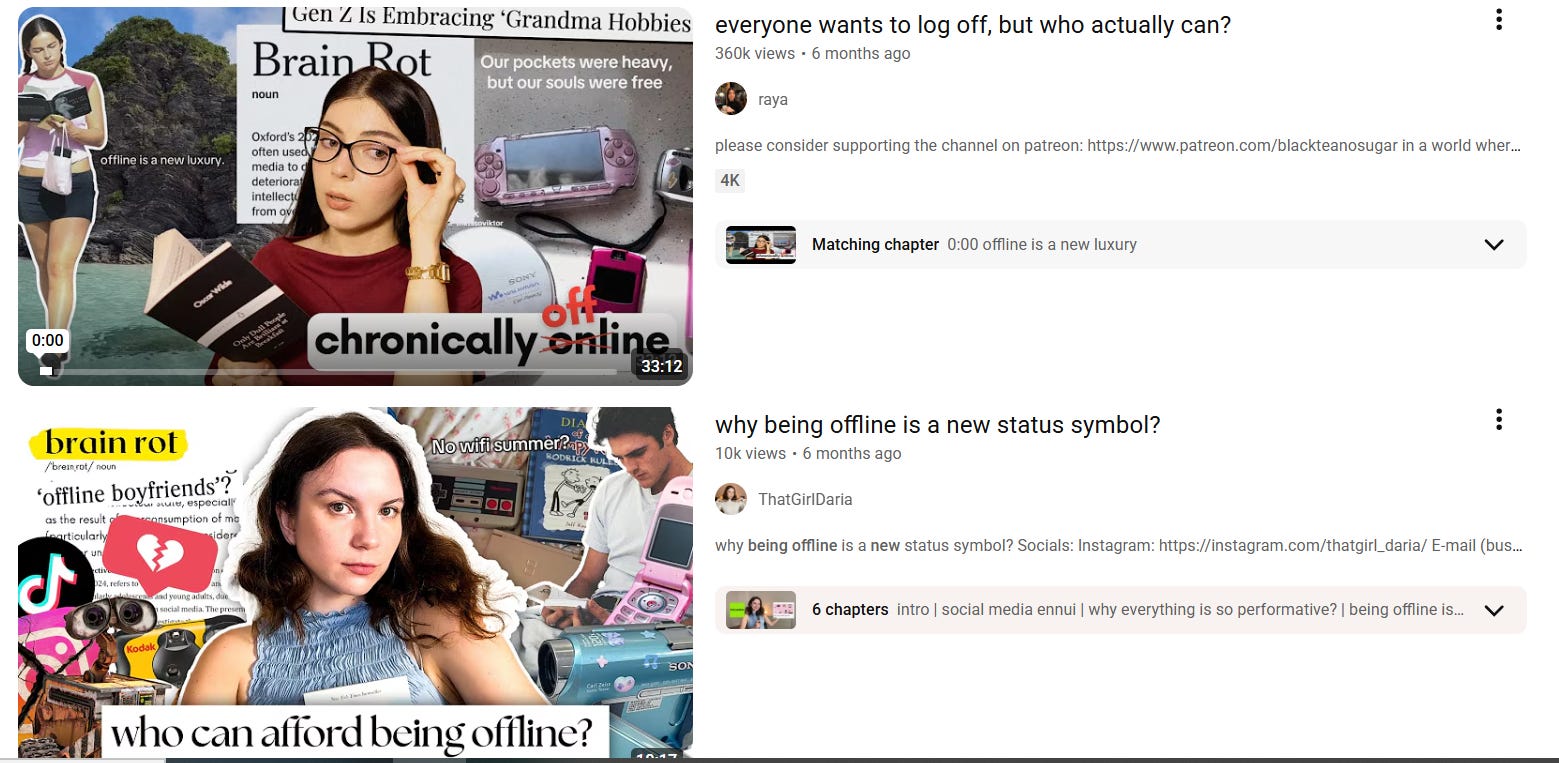
Part of India’s journalistic5 appeal is that she’s leading the charge against the harms of a phone-based culture. She is not doing this. Her belatedness means she must sometimes plaster over certain dominant narratives to make the cultural mood look worse than it really is. The tendency is particularly noticeable when she talks about AI chatbots. Take her discussion of Friend, a wearable AI companion brought out in 2025 by inventor Avi Schiffman. “I noticed a lot of excitement,” she says of Schiffman’s X comment section, conveniently leaving out the whole thing where he was made a subject of mass ridicule, and also the phenomenon in which New Yorkers gleefully and virally vandalised his poster campaign. The Atlantic called him “the most reviled tech CEO in New York”!
India says 70% of US teens have “tried out AI companions” but cites this report, which is pretty dicey about what a companion actually is (can you really isolate use of ChatGPT and Claude “as a companion” from “as a tool” when both chatbots are programmed to ask diagnostic questions, ask you how you feel, and speak in a friendly, approachable manner?) “Around a third of teens say they turn to these AI chatbots for ‘social interaction and relationships,’” she says, “whether that’s ‘conversation practice, emotional support, role-playing, friendship or romantic interactions.’”
This framing is a bit dishonest. We have breakdowns she’s choosing not to use: a respective 9% and 8% of the report’s full sample say they consider chatbots to be friends, or use them for “romantic and flirtatious interactions.” (This was a multiple-choice question; there is probably some overlap). It’s also a bit of a problem for India’s thesis that only 6% of the companion-using sample say they use them “to feel less lonely.” This is the least common answer to “Why do you use AI companions?”; the most common are “It’s entertaining” and “I’m curious about the technology.”
At another point she brings up some OpenAI research on companion chatbot use. “Some heavy users consider ChatGPT to be their ‘friend,’” she tells us; the citation in the book is to an UnHerd article which also uses “some,” and not to the research itself. But the research itself minimises her point. “Affective cues (aspects of interactions that indicate empathy, affection, or support) were not present in the vast majority of on-platform conversations we assessed,” the report says, “indicating that engaging emotionally is a rare use case for ChatGPT… even among heavy users, high degrees of affective use are limited to a small group.”
There is more. At yet another point, she chooses to talk about #Bedrotting as a post-Covid extension of the early-tens self-care trend (which is bad - because confidence, narcissism, no-fault divorce - more later!), conveniently leaving out the part where everyone knows bedrotting is a bad thing. There are 1.4m likes on this video in which a woman tells you how to stop bedrotting! If you search “bedrotting” on TikTok almost every video is about how it is bad for you, and then the people who say it’s good for you get flooded with comments about how it’s bad for you!
⋆.˚˖࿔ ࣪
Why is India trying so hard to combat trends that are already going out of fashion? I think I have a strong idea of what’s actually going on with this book and its pretext. This is because I am familiar with the underdiscussed, now-defunct pandemic-era Reddit community r/ConsumeProduct and how it eventually overlapped with hard-right political theory. The subreddit started off as a critique of the then-predominant urban, millennial, childfree and franchise-focused “hecking doggo” culture. Users made fun of “consoomers,” millennial men who eschewed married life to collect Funko Pops, pose in excitement with video game memorabilia, and drink the soy-based meal replacement Huel. More often than not, “consoomers” also “coomed,” which meant getting off to PornHub and giving money to camgirls on the then-ascendant OnlyFans.
As the subreddit grew, its dominant critique became conspiratorial.6 Users linked “consoomer” culture to a Jewish attempt to destabilise the West. On the hard right, everything leads back to birth rates: Huel was part of a plot to biologically feminise white men, or “soyboys,” so they couldn’t produce white children. Porn led to lower testosterone levels, promoted hookup culture, and sabotaged racial reproduction by portraying black men as more virile and desirable than their white counterparts. Consumer culture meant being bombarded by advertisements - and advertisers sabotaged racial reproduction too, demoralising the population by featuring white women in relationships with black men. The “consoomer” became an infantile “cuck,” who spoke in reverent terms about his “wife’s [black] boyfriend.”7 After being banned from Reddit for hate speech, r/ConsumeProduct found an alternative home on a clone site, where direct expressions of anti-semitism were commonplace and users openly urged others to “make white babies.”
One could make a convincing argument that the background concerns of r/ConsumeProduct are also the background concerns of Girls.® I am almost entirely convinced of this; my convincement peaked when I got to the end of her “CONSUME” chapter. (You cannot make these things up). “Coming of age with only consumerism as our guide, girls my age had no road map,” says India. We segue into an essay about infantilisation. She speedruns the established theses of Haidt’s Coddling of the American Mind and Jean Twenge’s iGeneration. Our consumer culture’s focus on self-expression slows our passage into adulthood; the economy means we delay our independence; helicopter parenting means we spend longer under adult supervision. Universities are embracing “safetyism,” bringing in therapy dogs and quiet rooms; the real world is selling us colouring books and telling us to “heal our inner child.” “Everywhere we looked, our infantilisation was indulged,” she says. Millennials keep talking about #adulting. Another direct segue. Aha! There it is!
“Delaying adulthood is not only more common and accepted now, but also celebrated. Growing up slowly is seen as freedom from old-fashioned constraints and obligations. One example of this is the rise of ‘child-free influencers’ in recent years, who not only normalise but glamourise the choice not to have children. Under hashtags like #childfree and #doubleincomenokids, young women on TikTok wonder why anyone would choose to have children and give up their future. They give glimpses into their child-free lives, from drinking wine in the Maldives by themselves to enjoying hungover McDonald’s breakfasts and uninterrupted naps… motherhood, meanwhile, is increasingly seen as restrictive, inconvenient and irrational.”
India cites her own article, in which she goes on to explain her whole thing against the #childfree:
“…According to a recent Pew survey, the top reason from those who don’t plan to ever be parents was ‘I just don’t want to’. Many of us,8 it seems, have simply been convinced we can sail through life without the meaningful anchors that previous generations grasped onto – and now, unsurprisingly, we find ourselves adrift… the trend for renouncing and disparaging motherhood because it interferes with living your best life or for fear of personal discomfort is a symptom of something more sinister: a society convinced that life should be fun and easy, all the time, to the point where we are beginning to show contempt for even the most natural of human instincts.”
These explanations barely figure in the book, and they’re not particularly fleshed-out here, either. It never occurs to India that some of these women might not feel “the most natural of human instincts;” it never occurs to her that mothers represented in previous statistics might not have wanted their children either, or that it might not be particularly healthy to build a society on unwanted children.
There’s also some bad-faith conflation going on. She’d prefixed the Girls® passage with an explanation of #adulting, the online phenomenon in which millennials make a big deal of basic administrative and maintenance tasks. We go into her explanation of #childfree ready to assume that its adherents are similarly incapable; she calls it “growing up slowly.” But the examples she cites are less about self-infantilisation than free will. You can’t live the glamorous #childfree life if no money is coming in, and you’ve got to be a responsible adult to earn it. If you’re drinking wine in the Maldives, you probably have a job paying a few deviations above the average; if you’re using the #doubleincomenokids hashtag, that’s both a job and a stable adult relationship!
We find these strange, written-as-obvious digressions about childlessness strewn through the book. At another point, India speedruns from 2016-era studytubers to LinkedIn to Lean In culture. “Soon we were being encouraged to find self-worth and fulfilment through our careers,” she writes. “For teenage girls like me, our goal in life was to become a girlboss.” OK Freya very cool and not particularly wrong. But wait? What’s this? A segue?
“Family life was increasingly organised around work… [discussion of breast milk shipping, corporate offices providing childcare, Yahoo! CEO giving birth on the job]… Girls my age grew up with this messaging. For us female empowerment had always meant putting career first, and everything else second… but then… the pandemic hit… we finally had time to think about what we were doing, and where we were headed. Girls who had given everything to academia found themselves lost and unfulfilled. Young women who had spent years pushing themselves in the corporate world began to break down and burn out. We realised how much we had been sacrificing, and wondered whether it was worth it.”
India keeps using the second-person plural, as if she is speaking for The Girls.® But she isn’t. She’s doing something clever-ish where the individual facts are mostly present and correct, but the actual substance of her argument lives in the segues. Her freeform Hararian style gives her an awful lot of license to do things like this. When you jump straight from details about motherhood in corporate culture to an emotive discussion of pandemic-era burnout, you give the impression that Gen Z women are burning out because they want to be mothers. They aren’t! There is no evidence to support this!
The rest of the passage is saddled with problems. The “academia… lost and unfulfilled” point is a total digression with absolutely no evidence to back it up, not even anecdotal evidence. She moves onto the phenomenon of “quiet quitting” and “lazy girl jobs” before funnelling us briefly into the concept of “tradwives.” She makes no mention of the essential political dimension of the “tradwife;” here it’s a more-or-less logical response to the excesses of “girlboss” culture, and it’s sandwiched usefully between “lazy girls” and “stay-at-home girlfriends.” (Tradwives come up again in a discussion of consumer culture. There they’re also depoliticised, framed as an “aesthetic” to be swapped with “Dark Academia” and “Tomato Girl”. But they were never an aesthetic! Cottagecore was the name of the aesthetic!)
We move on. More issues. Now women - “even the Trad Wives on TikTok” - are selling themselves - “becoming a brand, a product.” “Every moment of our lives can be monetised,” she says for the trillionth time, “every aspect of who we are commodified.” She jumps from this to an American pro-entrepreneurship magazine called Teen Boss, which ran for a grand total of fifteen months, was widely slated by critics, and shuttered before TikTok was even called TikTok.
Another immediate and suggestive segue. “Even fairy tales have been rewritten,” she says, describing someone else’s account of the trailer of 2021’s disastrous Cinderella remake. The “princess wants her own fashion empire, not Prince Charming,” she quotes; the princess turns down his proposal with the line “But what about my work?” India is talking about a plot point halfway through the film; the princess ends up running off with the prince and pursuing her fashion empire.9 Why doesn’t she mention this? What does a retold fairytale have to do with personal branding in the age of social media? And is the issue that women are being commodified by Big Tech, or that women are choosing their careers over husbands and children? Why does India keep making emotive condemnations of the former while slotting in examples of the latter?
India’s short section on “FAMILY” is a bit odd, chiefly because she’s trying to set up a part-Laschian, part-Furedian theoretical pretext while only citing Lasch once - and at the very end of the book. “The pursuit of personal growth and emotional fulfilment,” she says, “had in the last few decades become much bigger priorities [than family life]… with freedom seen as the ultimate goal, spouses became distractions and inconveniences.” Divorce, she says, is seen as “a path to self-actualisation, another means of female empowerment… instead of family breakdown being discussed with sympathy and concern, girls today see it trivialised and glamourised.” As evidence, India cites several pro-divorce pieces in Vogue, the Guardian, and the New York Times, all of which are actually aimed at women of marriage age.
She heralds the chapter by describing the US introduction of no-fault divorce as “support systems… collapsing.” Then comes a description of two TikToks in which young women cry about their divorced parents; India situates us by saying “I’m scrolling through the hashtags #divorce and #divorcedparents.” But on investigation, only one of the two videos bears either hashtag. The other is emotive and therapeutic, but pretty standard: “No one talks about how your childhood affects your relationships,” says the text. “Fear of abandonment and overthinking about people leaving you all the time sucks.”
This is the thing: we don’t know what happened to the girl in the video. She hasn’t used the #divorcedparents hashtag; she hasn’t signed up to serve as evidence for a wave of pro-authenticity cultural change. India’s always noticing and narrativising social media trends, but she never once provides firsthand reportage that isn’t a highly emotive account of her own life. She never once speaks to her Gen Z peers. It could be that this would cause her political inconvenience; it could be that they’d catch her out as a latecomer and not a forerunner. The most likely answer is probably that she just isn’t interested.
The press response to India’s debut has been fairly tame so far. It’ll be interesting to see what happens once the book releases in America, which currently has a larger and glossier left-wing media apparatus and a more resounding trend of granular book criticism. Sarah Ditum points out that India “isn’t always intellectually straight,” but doesn’t have enough space to explain exactly why. (One of the limits of the traditional book review: today’s middlebrow nonfiction is stuffed with “freeform facts,” and it’s always hard to have a proper go at them in a thousand or so narrativised words). Zuzanna Lachendro points out that India’s proposed solutions are individualistic and therapeutic enough to echo her proposed problems. After trying to counterpose Girls with Zoe Strimpel’s parallel-opposite but better-faith Good Slut, Emily Bootle is doomed to repeat the book’s surface-level premise.
Meanwhile, India’s been kicking off about her reputation as a containment-breaching media personality. On her Substack: “Nothing can be complicated; all must be clickable. I write about consumerism so can’t possibly sell a book, I write about conservatism so must be far-right, I write about girls so must hate men.” (If India was “writing about conservatism” this would have been a very different book). Today, in Catholic journal First Things: “I’m often accused of only pretending to care about girls and young women because I have conservative instincts. These are incompatible, apparently; any compassion I have for girls must be a front for an evil political agenda.”
A particularly interrogative Times interview appears to have set her off. The writer, Harriet Walker, points out she’s close friends with the Trump-and-Farage-adjacent Oxford academic James Orr. (India thanks her in her acknowledgements for offering her the use of his house; he bills his podcast as a place where “timeless wisdom challenges civilisational upheaval”). Walker calls her a “conservative Christian.” But we’re never able to work out what this means for the book itself, and the Times marketing leads us the wrong way.10 She’s the “anti-woke voice of Gen Z women,” even though almost all her commenters are middle-aged men; if you listen to the strapline then she’s a legitimate tech critic who also happens to believe in “God and traditional family values.”
India is not attacking a bipartisan issue from the right. We must stop pretending this is happening. Girls uses a widely-accepted problem as cover for a completely different ideological aim. It takes the New Right’s theory of civilisational collapse and repackages it into pseudo-feminist concern. It is a work of pure entryism, designed entirely to compensate for a historical lack of right-wing influence on middlebrow women’s culture. We follow India’s deluge of facts and half-facts from one point to another; the point of the facts is where they go. And in Girls they only take us in one direction: out of sight, out of school, out of the office, off our meds, and back into the home.
⋆.˚˖࿔ ࣪
Corollary 1: there’s an interesting thread going on in the background of Girls and it’s high time someone discussed it. India dedicates the book to an Evan. I’d received tipoffs about a managerial boyfriend figure; some investigation surfaced Evan W. Riggs, who is based at the Foundation for American Innovation in Washington DC. India attests to the Times that she has now moved to the city; Riggs seems to have travelled to the UK during India’s launch week, flying back during America’s bombing of Iran. His LinkedIn states he was based in the UK between 2022 and early 2025, working as a freelance “Communication & Production Consultant” who “collaborated with many high-profile public intellectuals and institutions.”
On X, Riggs is now mostly a pro-growth startup guy - but his feed is also more or less a full record of India’s career. So far this year he has retweeted her Cluny Institute speaking announcement, her post about her own launch party, a post in which someone else spots her book in a bookshop, a post from Jonathan Haidt congratulating her on her book, a post from James Orr saying the same, an excerpt from her book in the Free Press, a post from Francis Foster about her Triggernometry appearance, her own book release announcement, the Triggernometry appearance itself, another of her articles in the Free Press, a book release announcement from India’s publisher, one of her articles in After Babel, her post recapping an IAI appearance, her post telling people to preorder hardbacks, and her post about receiving her own advance copies.
While in the UK, Riggs was closely associated with the late Peter Whittle’s New Culture Forum, co-anchoring its “youth discussion” podcast Deprogrammed with Harrison Pitt of the European Conservative (now also Restore Britain). The drift of Deprogrammed is generally identitarian, and Riggs’ contributions reveal a preoccupation with Western female fertility and replacement theory. On one episode, he’s co-hosting podcaster Fleur Meston in a discussion about birth rates. “It’s really great for me to have that goal [motherhood] to head towards,” says Meston, “because I do feel like a lot of young women who have grown up with the girlboss image, and shows like Sex and the City, and magazines telling you like female empowerment and casual dating and your career is everything, have been brainwashed to think being a mum isn’t enough.”
This is what Riggs says in return:
“I really worry actually… about what the punishment that is going to be inflicted on society is going to be, from a lot of women who are now coming into maybe their late 30s to 40s or even in their 20s and still able to have kids but are just not going to get there… when they… realise this massive aspect of what it means to be a human or to be a woman has been kind of stolen away from [them] on [the basis] of this pack of lies.”
Again, in an episode with Connor Tomlinson:
“I think the problem, too, that you [Tomlinson] address in your article and it’s something that we are inevitably going to deal with… is like you have the freedom to kind of pick whichever horse you might want, and just sort of, you know, meander around in a stable without actually really going anywhere, but by the time you hit 35 and you realise “Oh, I would actually have liked to uh made my way to a house and 2.1 kids, and you know, a loving family, I should have probably started out on that journey seven years ago. I think a lot of latent rage, for lack of a better term, is going to be expressed by women against men and I think against society in general, and I think we’re starting to see that now… I don’t know if you guys saw the video of the schoolteacher berating a student about not accepting another one of the students as being a cat or catgender in this attempt to proselytise and convert past… normal acceptable boundaries… to really be a kind of devouring mother, as [Jordan] Peterson might say, to her own pupils.”
In “Demography is Destiny: Birth Rates and the Survival of Liberal Britain,” he’s speaking in Great Replacement terms:
“My worry is that compassion - and I agree that compassion is very good, but that it has a dwindling fuse - I think you’ve pointed out that at current trends, Britain will become a white ethnic minority state in 2060 or 2070… [guest clarifies statistic]. If that happens, and I can’t think of a single example where a country has had a demographic shift not like warfare or invasion, but basically a trickle coming into a flood… I think that compassion immediately goes away, if you basically told white British people, “You’re now at 49%,” that compassion dissipates overnight, and I think what will then replace that will be like seething resentment.
⋆.˚˖࿔ ࣪
Corollary 2: there will be more Freya Indias, and they will probably be even worse than the first one. Compare the Take Economy to the actual economy: you’ll find it is actually much more sensible to set out as a young female pundit than to try your odds on the graduate job market. And the only media sphere accommodating Teen Messiahs is the one on the right. I’ve noticed the phenomenon more and more in the past year: a host of bright-ish, ambitious, privately-educated young women with existing press connections are cancelling themselves to get their names in the paper and their faces on TalkTV. It’s working, and it’s quite ingenious. They know any vitriol thrown at them will mean thousands of middle-aged Twitter followers, and plenty of middle-aged column inches, and lots of appearances on middle-aged TV. But the strategy is short-sighted. Eventually they’ll age out of the Teen Messiah schtick and realise they could have established a reputation for something more sustainable, like words or ideas.
I’m aware there are people reading me because I sometimes Attack The State Of Things As A Very Young Woman, How Brave Is That?. I was originally pulled in this professional direction because my journalism career started at the Spectator, which boasts an admirable literary tradition but also has a readership with an average age of about a hundred.11 I did really well writing for the Spectator because I have read lots of Waugh and Vidal and seen lots of films with Bette Davis in them, which means I am good at writing scathing sentences. This is great when you’re doing stuff about your own experiences and opinions, and less great when you are established enough to take commissions that come from someone else.
There is a phenomenon that happens all the time to young women like me, and it goes like this: your editor (who is also actually quite young) will email you with a suggestion.12 You’ll be like - yes, I’m short a commission and I do kind of fancy writing about my time on Tumblr! Tumblr really did influence politics and culture in a way we are yet to reckon with! I could get some good scathing sentences in! Then the article will come out like “I’M IN MY TWENTIES AND HERE’S WHY I’M NOT LIKE MY IDIOT PEERS.” You don’t get that much money and then the agèd commenters make fun of you anyway.
All this and you are still only halfway into British intellectual life. You might spend hours and hours thinking and pitching and writing but you are still not really a thinking woman. You are merely a token, an example of a woman.13 You are in the media on someone else’s terms. Your readers will abandon you the second you choose a more interesting subject or find a more nuanced conclusion; you exist to serve as living proof of the future they want, which might not be the same as the future you want. It must be the worst deal on Fleet Street. Won’t somebody please think of the children?
This was sooooo long so here are multiple music recs.
Armenian Ray of Light:
Probably peak mid-00s Mandopop:
Shibuya-kei you need to hear:
You see these outros all the time. They are just hedging. Nine times out of ten the writer actually does want to enact the policies they spent most of the word count arguing for and are just doing damage control. Or the sentence is added by an editor. The people who keep saying “identity politics are a distraction” are among the most distracted by identity politics.
Camus has rejected accusations of anti-Semitism but it remains very prevalent among his sphere of influence. Watch for X users doing “early life checks,” reptilian stuff, etc.
Lyons’ use of the Chinese character 乱 “upheaval” to illustrate his blog is probably intended to make him come off as a Daoist sage, but it actually reminds me of early-90s house group the Shamen.
Far be it from me to criticise what women wear when we’re still a few weeks ahead of the Met Gala, but it IS actually a bit weird that Freya India and Jess Gill (etc.) are walking around central London and going on podcasts recorded in fancy offices while dressed exactly like the tradwife Wojak. (Also do they not ever get cold??)
lol
This is where a lot of the current Lindy West criticism is coming from BTW. Yes her turbo-millennial writing style is irritating but I don’t think the pundits giving her “advice” are being entirely selfless.
NB. she’s talking about millennial statistics but still using the second-person plural, I guess as a rhetorical tool? She isn’t a millennial.
Why do I feel like I just learned more about the 2021 Cinderella remake (against my will) than Freya India did while researching her own book.
If you’re not familiar - headlines and straplines are almost always written by sub-editors. Taylor Lorenz has had a go at the Times for this article but I think Walker has done a pretty good job.
No offence to them. But also my friend once wrote something bitchy but innocuous about a certain British seaside town favoured by the elderly and one commenter said “Why don’t you just die?”
This doesn’t apply to the outlets I write for at present/the editorial team I generally work with, who always treat me like I am a real person with proper thoughts, even if they are sometimes outré thoughts. I am very grateful to them and I wish the same treatment on every Girl®.
I made the mistake of being nice to a GB News producer who was referred to me about a year ago and have since turned down six different appearances, none of which had any relevance to anything I’d ever written about.